


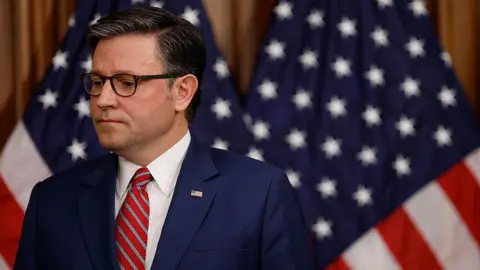
 Getty Images
A budget proposal that would terminate the most extended government shutdown in the nation's history is heading to the House of Representatives for a critical decision on midweek.
On the sixth week of the political impasse, lawmakers are reassembling in Washington to vote on whether to pass a legislative agreement that would finance federal agencies for 60 days.
Republican leadership voiced optimism the funding measure would clear the lower chamber, despite their narrow majority. But leading opposition members pledged to fight it.
"We're reopening our nation," he declared on yesterday at a military commemoration in Arlington, Virginia. "Never should have been halted."
Impact of the Funding Lapse
The funding gap, which started on 1 October, has caused a government employees without pay, stopped SNAP benefits for economically vulnerable citizens, and slowed flights for flyers ahead of the family gathering season.
With over a thousand trips cancelled on the previous day as unpaid air traffic controllers report illness because of the budget impasse, legislators are seeking alternative methods to travel to DC.
- Congressman Rick Crawford of his home state announced online that he was traveling together with a GOP colleague, the Mississippi congressman of Mississippi, to the Washington DC.
- The Wisconsin lawmaker stated he would be driving a Harley Davidson motorcycle from his constituent state of the Midwest state.
"It will be a somewhat brisk," he posted on the platform of the extended journey. "But I will perform my responsibilities."
Congressional Procedure
The House Rules Committee approved the measure in a procedural party-line vote by 8-4 in the early hours of the crucial date, ending a extended meeting.
Majority party representatives brushed aside opposition proposals attempting to prolong ending healthcare support - their primary requirement during the standoff.
The chamber is expected to reconvene at 16:00 EST (21:00 GMT) to hold one hour of debate on the proposal before a decision.
Minority Position
Democratic leader Hakeem Jeffries of New York pledged to oppose the bill.
"We completely reject as Democratic representatives to this reckless Republican effort to persist in increasing the high cost of living on ordinary citizens," he stated to the news network.
The minority representative has voiced disappointment with Senate Democrats who aligned with the majority party on the night before to pass the funding measure.
Key Issues
A key condition of Democrats during the closure has been that Republicans include in the spending bill a provision to continue tax credits that make health insurance more affordable for 24 million Americans.
But GOP members stayed united and refused to budge, agreeing only to allow a decision before year-end on the medical assistance, something they had offered previously.
And there is uncertainty that legislation will be approved by the Senate, while the presiding officer has yet to commit a vote on the tax credits in the House.
Political Dynamics
The Speaker has maintained congressional recess for 53 days to increase leverage against opposition senators to agree a shutdown compromise.
Ahead of the decisive decision he will administer oath to Arizona congresswoman-elect Adelita Grijalva, a member of the opposition who was elected in a by-election in the previous month.
Once she has taken the congressional commitment, the GOP advantage in the House will be whittled down to five votes – 219 to 214.
That means Johnson can only afford to lose two Republicans on each partisan ballot.
Budgetary Issues
The spending plan leaves the US government on course to keep adding about $1.8tn (1.4 trillion pounds) a each year to its massive existing in debt.
But the conservative lawmaker of the Lone Star State said he was "unfamiliar with dissent of importance" to the proposal from fiscal hawks in his conservative group.
Likely majority party opponents Thomas Massie of the Bluegrass State or the potential dissenter of Indiana have remained tight-lipped so far on how they plan to vote.
But should they actually break ranks, the legislative leader could potentially pass the legislation with the assistance from moderate Democrats, such as the Maine representative of the Pine Tree State or the conservative-leaning representative of the southern state.
Public Perception
No political group appears to have emerged without damage from this congressional crisis.
Public opinion research indicate voters believe Republicans carry a bit more of the culpability, while the opposition were deeply fractured by the brinkmanship.
And when the closure concludes, funding legislators have merely eight weeks to prevent the following crisis.
Federal appropriations would next be due to expire on 30 January.


