


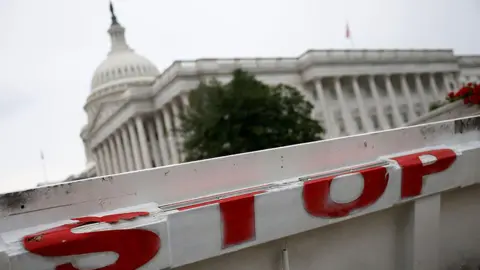
The United States government shutdown has entered its 36th day, establishing it as the most prolonged duration of government closure in American history.
This closure, which started on October 1st, was caused by Congress's inability to agree on a new funding deal. This has resulted in federal employees without paychecks and millions of Americans without essential services.
Democrats and Republicans have remained gridlocked for weeks with no indications of agreement - although faint signs of progress are beginning to show.
"My feeling is, from my gut of how these things operate, I believe we're getting close to an solution here," the Senate's top Republican commented.
The former closure milestone happened under President Trump's first term and lasted 35 days before it ended in 2019.
Increasing Impacts on Citizens
Over recent weeks following the shutdown's start, the consequences on everyday Americans have worsened.
Numerous federal workers have not received their salaries, and there are increasing concerns about disruptions in aviation across the US as flight controllers and airport staff work without pay.
"If you bring us to next week, you will see mass chaos," the Transportation Secretary stated. "Expect mass flight delays. There will be mass cancellations, and we might need to close certain parts of the national airspace, because we just cannot manage it because we lack sufficient air traffic control staff."
Nutrition Benefits Crisis
The impacts have also been felt by economically vulnerable citizens who depend on government services.
One in eight Americans are reliant upon food assistance from the SNAP program, but only a portion of that assistance is being distributed currently due to lapsed funding.
The previous administration had - at first - said no food assistance money would be distributed in November but a US court mandated that emergency resources be used to provide citizens some assistance.
"Food assistance will be provided only when the opposition party open up federal operations, something they can readily accomplish, and not before," the former president wrote on his preferred platform.
Legislative Stalemate
Lawmakers in the American Senate have considered the same short-term funding bill to reopen the government more than a dozen times with unsuccessful results. Attempts were made once more recently to no avail.
The legislation passed the lower chamber in September.
Democrats have so far declined to back the short-term measure on government funding except if Republicans consented to continue healthcare subsidies for low-income Americans. The governing party have resisted, claiming Democrats of holding the government hostage over unrelated policy priorities.
"If we don't start seeing any advancement or some evidence of movement by at least the week's midpoint, it's hard to see completing anything by the end of the week," the legislative leader told reporters. "And I think that represents the objective here, is to try and reach an agreement that we could send to the lower chamber that would restart the government."
In recent days, there have been signs that some moderate Democrats and Republicans are keen to discuss and reach an agreement ahead of Thanksgiving on 27 November.
- Understanding the Federal Closure: Reasons and Results
- Food Assistance: When Will Assistance Persist Through the Government Shutdown?
- Five Ways the Federal Closure is Affecting Citizens - And How Conditions Could Deteriorate

